

Chiron the Wounded Healer

Updated: Mar 16
When Our Wounds Become Our Medicine
There are certain symbols that we notice appear at different thresholds in our lives, return in dreams or meditations, and keep placing themselves in front of us until we are willing to understand what they are asking of us.
That has been Chiron for me.
He first appeared near the beginning of my awakening in 2012, and over the years he has returned at pivotal moments in meditation and healing work as teacher and a guide (sometimes even having a blackboard to write on). He has shown up to instruct, to mirror, and to challenge.
Many of us learn how to hold, guide, soothe, witness, and give long before we learn how to receive support ourselves. We become fluent in offering medicine while quietly resisting our own. We become strong in ways that look wise from the outside, while still carrying grief, rejection, shame, and questions of identity that have not yet fully settled inside us.
That is part of why, I believe, the figure of Chiron has stayed with me. He represents the deeper paradox of the healer’s path. In Greek mythology, Chiron is not the wild, chaotic centaur people might expect. He is known for wisdom, medicine, teaching, and mentorship. In the mythic tradition, he is also the one who bears a wound he cannot simply heal away. That paradox is exactly what gives him such enduring symbolic power.
Who Chiron Is in Mythology
In Greek mythology, Chiron was not like the other centaurs. Centaurs as a group were often portrayed as unruly, impulsive, and given to drunkenness, lust, and chaos, but Chiron stood apart from them. He was known as wise, civilised, just, and deeply skilled in the healing arts. He became a teacher and mentor to heroes, including Achilles, Jason, and Asclepius, and was remembered not for brute force, but for knowledge, restraint, and service.
Chiron’s story takes its most powerful turn when he is accidentally wounded by a poisoned arrow shot by Heracles during a conflict involving the other centaurs. Because Chiron was immortal, he could not simply die from the injury, yet he also could not heal it. The wound became incurable, leaving him trapped in ongoing pain despite being a master of healing himself. Making him, the wounded healer. A healer that could tend to others, teach others, and guide others, yet still carried a suffering he could not resolve through skill alone.
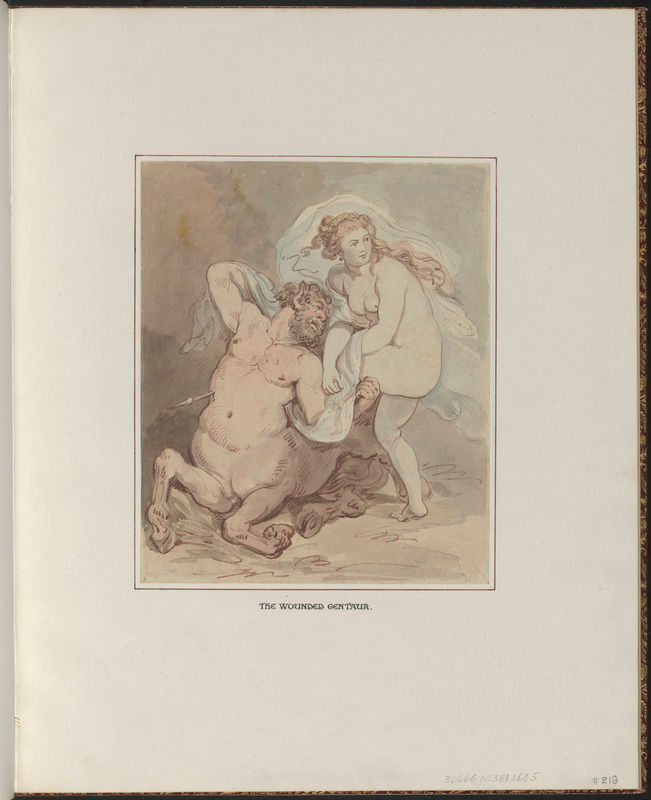
Eventually, Chiron chose to surrender his immortality so that Prometheus, who had been condemned to eternal torment, could be freed. In doing so, he released both himself and Prometheus from endless suffering. This part of the myth is what shifts Chiron from being merely tragic to becoming spiritually and morally significant. His wound did not just symbolize pain. It symbolized sacrifice, compassion, and the strange way suffering can deepen character, wisdom, and service when it is consciously borne. Afterward, Zeus placed him among the stars. In some versions this is linked with Sagittarius, while in others it is associated with Centaurus, but in either case the image is the same: Chiron’s life, pain, and goodness become part of the heavens themselves.
What makes Chiron so compelling is that his wound is not framed as meaningless. It becomes symbolic of the transformative power of suffering and of the way personal pain, whether physical, emotional, or spiritual, can become a source of strength, humility, and wisdom. Not because pain is automatically noble, and not because suffering makes someone enlightened by default, but because what is endured and integrated can shape a person into someone capable of guiding others with depth, compassion, and integrity.
Why the Wounded Healer Still Resonates
Suffering does not automatically graduates someone into wisdom. The power of Chiron is not simply that he was wounded. Plenty of people are wounded, I'm sure many of us could name a handful of people we know that carry wounds, ourselves included. The power is in what the wound reveals, heals, and eventually reshapes. Chiron symbolizes a deeper reality: those called to healing, teaching, mentoring, or guiding others are often people who have had to reckon with pain in profound ways. That experience can deepen compassion and discernment, but only if it is consciously worked with.
Pain has a way of forcing honesty. It can expose where identity has been built around survival. It can strip away fantasies, deepen humility, and make a person less interested in performance and more interested in truth. But a wound does not become medicine simply because it exists. A wound becomes medicine when it has been tended, metabolized, and integrated enough that it is no longer unconsciously leading the work.
Jung and the Wounded Healer Archetype
The modern language of the wounded healer is closely associated with Carl Jung. Medical and psychological literature discussing Jung’s work used the term as an archetypal dynamic to describe how a practitioner’s own suffering can affect the healing relationship, both positively and negatively. He argued that the healer’s own hurt can become part of their power to heal, because it deepens humanity, insight, and self-examination.
That matters because it humanizes the healer. It removes the fantasy that the one helping others must be untouched, perfected, or somehow floating above ordinary struggle. It recognizes that many practitioners carry histories, griefs, sensitivities, and wounds of their own.
On one side, the concept is deeply humanizing. It means the healer is not imagined as some untouched authority floating above ordinary struggle. It recognizes that those who guide others are still human beings with histories, griefs, sensitivities, blind spots, and ongoing processes of their own. On the other side, Jung’s wounded healer is not a permission slip for unresolved pain to masquerade as wisdom. The same literature that describes the archetype also points to the risk: when the practitioner’s wounds remain unexamined, they can distort the helping relationship rather than deepen it. Personal pain can increase empathy, but it can also create projection, over-identification, rescuing dynamics, porous boundaries, or the need to be needed.
The healer does not need to be perfectly healed. That is a fantasy, and a boring one at that. But integrity is not optional. Self-awareness is not optional. A real relationship with one’s own material is not optional.
Being human is not the issue. Refusing to be honest about your humanity while working with others usually is.

Chiron in My Own Healing Journey
My connection to Chiron has been lived experiences where he has shown up for me when, unbeknown to me, I needed it.
As a Sagittarius, there was always a personal connection through Chiron with the archer symbolism. Chiron first showed up for me near the beginning of my awakening in 2013, when many things in my life were already shifting under the surface, during a Reiki healing session he came in his centaur form and with a blackboard. He has always been a teacher and a guide for me. (some would say ascended master even) Since then, Chiron has come in at pivotal moments, sometimes showing up in things I am reading or conversations I am having. but most powerfully through meditation and healing experiences.
One of the most powerful moments came in early 2025 during a deep meditation where he laid his bow and arrow at my feet. It was a powerful and emotional experience and gesture as I was reminded of the story of Chiron and Prometheus and the sacrifice Chiron made to end Prometheus' torture and suffering.
The bow and arrow felt like permission to let go of what I had been carrying and to lay it down at his feet, to give it up and to stop the suffering and the torture. It was a strong invitation to stop existing only in the role of the one who gives. An instruction to receive.
That lesson feels even more significant when I look at my own Chiron placement. My Chiron is in Cancer in the fourth house, which speaks to wounds around home, belonging, emotional safety, care, and the deeper roots of identity. It points to the tender places connected to being held, to family, to nurturing, and to the inner foundation a person builds their life on. At a few months old I was put up for adoption, spent a short time in foster care, before being adopted into my family. So for me, that has resonated deeply with the parts of my journey shaped by grief, shame, rejection, and the ongoing work of understanding what it means to feel safe enough to soften.
Cancer in the fourth house carries a wound that lives in the private spaces. It can show up in the ache to belong, the instinct to protect, the fear of being too much or not fully held, and the habit of becoming the caretaker, the container, the one who senses what everyone else needs. It can make a person deeply attuned, deeply protective, and deeply capable of holding others, but also uneasy with their own need to be held in return.
We tell ourselves we are being strong, or useful, or generous, when really we may be avoiding our own vulnerability. We may be more comfortable being needed than being seen. More comfortable offering medicine than admitting where we still ache. Chiron, for me, has never just symbolized pain. He has symbolized the sacred discipline of not hiding inside the healer role.

When I reflect on Chiron in Cancer in the fourth house, I can see both the wound and the medicine. The wound lives in the tender architecture underneath everything: belonging, safety, emotional trust, home, identity, and the need to feel held without having to earn it through service, strength, or caretaking. It can show up as becoming the one who nurtures others while quietly struggling to receive that same care. It can show up as old grief settling into the body, shame shaping the inner world, or rejection making a person feel as though they must become useful in order to remain connected.
The healed expression is not the absence of sensitivity. It is the restoration of it. It is the ability to create safety without controlling everything. It is the ability to nurture without disappearing into the needs of others. It is the ability to build a home within yourself sturdy enough that your medicine no longer comes from proving your worth through how much you can carry. It is learning that care can move both ways. It is allowing softness, receptivity, and emotional truth to become part of your strength rather than something you hide behind competence.
Grief, Rejection, Shame, and the Making of a Healer
A lot of people who are drawn to healing work have intimate relationships with grief, rejection, shame, sensitivity, and even fractured identity. Many practitioners did not arrive on this path because life was easy and they thought energy work seemed cute. They arrived because something in them had been pressed, broken open, or forced into deeper awareness.
That does not automatically make someone wise. But it can make them available to a kind of wisdom that people untouched by those experiences may not understand in the same way. For me, part of the path has been learning that being a healer does not mean rising above those realities into some polished spiritual identity. It means meeting them honestly. It means learning the difference between working from the wound and working with wisdom that has come through the wound. It means allowing grief to teach without turning it into a throne. It means allowing rejection to shape discernment without making it your personality. It means allowing shame to be metabolized rather than hidden under spiritual language.
The same pain that once made you reactive can, through deep work, make you compassionate without collapsing. The same shame that once distorted your identity can become the place where you build honesty. The same rejection that once made you grasp for belonging can become the place where you stop abandoning yourself.
When Pain Becomes Medicine
Your deepest pain may become part of your medicine, but only when it is integrated and not still the wound leading the work.
There is a huge difference between someone whose pain has given them humility, depth, and discernment, and someone who is still unconsciously organizing their work around their unmet needs. One may be able to sit with others in a way that is clear, ethical, and deeply human. The other may seek validation, control, specialness, or intimacy through the very act of helping.
Integration does not mean you never get triggered. It does not mean every part of your story is tied up in a neat little bow. But it does mean that you have enough relationship with your own patterns that they are not dictating your practice from the subconcious. You know how to pause, reflect, receive support, and take responsibility. You can recognize when something belongs to you and not make it your client’s job to carry it.
What the Wounded Healer Archetype Gets Wrong When Romanticized
Being wounded does not automatically make someone a healer. Being intuitive does not automatically make someone safe. Having suffered does not automatically make someone discerning, ethical, or prepared to guide others. Pain can deepen a person, yes. It can also make a person hungry, reactive, inflated, collapsed, or unconsciously attached to being seen as important.
This is why I care so much about integrity on the practitioner path.
A healer does not need to be beyond pain, beyond grief, or beyond being human. That would be ridiculous. But they do need to know the difference between offering from grounded presence and offering from an open wound. They need to know when they are truly serving and when they are trying to get something back through the role itself. That is where Chiron continues to teach.
What This Means in My Work
This understanding sits underneath how I approach healing and mentorship. I do not believe the path asks us to become flawless vessels before we are allowed to support others. I believe it asks for ongoing relationship with ourselves. It asks for humility. It asks for self-responsibility. It asks us to be willing to receive healing too, not just facilitate it. It asks us to keep meeting the places where grief, shame, rejection, and identity still live in us, not because we are failing, but because this is part of being human while doing sacred work.
It also asks us not to confuse being activated with being called. Not every unprocessed wound is a gift waiting to be given. Not every painful story is ready to become medicine simply because it hurts. Some things still need tending. Some things still need containment. Some things need to breathe in privacy before they are ever asked to serve anyone else.
In my own work, whether in healing sessions or on the mentorship path, I care deeply about supporting practitioners and clients in developing discernment around this. Not perfection. The ability to feel what is true. The willingness to be honest about where you are. The courage to let your medicine be shaped by what has actually been integrated, not just what sounds meaningful when spoken out loud.
Chiron and the Path of Becoming Whole
Chiron remains powerful because he does not offer a fantasy of transcendence. He offers something more demanding and more useful. He shows us the healer as teacher, mentor, and bearer of wisdom. He also shows us the healer as one who has encountered suffering intimately. Through Jung, this myth became an enduring archetype for the helping professions and for anyone whose service is shaped by lived pain. The image persists because it tells the truth: some of the deepest medicine is born where suffering has been met honestly and transformed through consciousness, not bypassed, not romanticized, and not turned into identity.
For me, Chiron has been a companion at thresholds. He has appeared when I needed instruction, correction, and reminder. The bow and arrow laid at my feet were not only symbolic of what I give. They were symbolic of what I had to finally allow myself to receive. That is still part of the teaching.
The healer’s path is not about becoming untouched. It is not about proving you are beyond your grief, your shame, your history, or your humanity. It is about becoming honest enough, integrated enough, and grounded enough that what once wounded you no longer unconsciously leads the work. At that point, what has been lived can begin to offer wisdom. What has been grieved can begin to offer depth. What has been integrated can begin to offer medicine.
FAQ
What does Chiron mean as the wounded healer?
Chiron represents the paradox of the healer who carries their own wound. In mythology and Jungian thought, this points to the way pain can deepen wisdom and compassion when it is consciously integrated.
Who was Chiron in Greek mythology?
Chiron was a wise centaur known for healing, teaching, and mentoring heroes such as Achilles, Jason, and Asclepius. Unlike the other centaurs, he was remembered for knowledge, restraint, and medicine.
What is the wounded healer in Jungian psychology?
Jung used the wounded healer as an archetype describing how a practitioner’s own suffering can deepen their ability to help others, while also creating risks if that suffering remains unexamined.
Does a healer need to be fully healed to help others?
No. But they do need integrity, self-awareness, and an ongoing relationship with their own healing. The issue is not being human. The issue is working with others from pain that is still unconsciously leading the work.



Comments